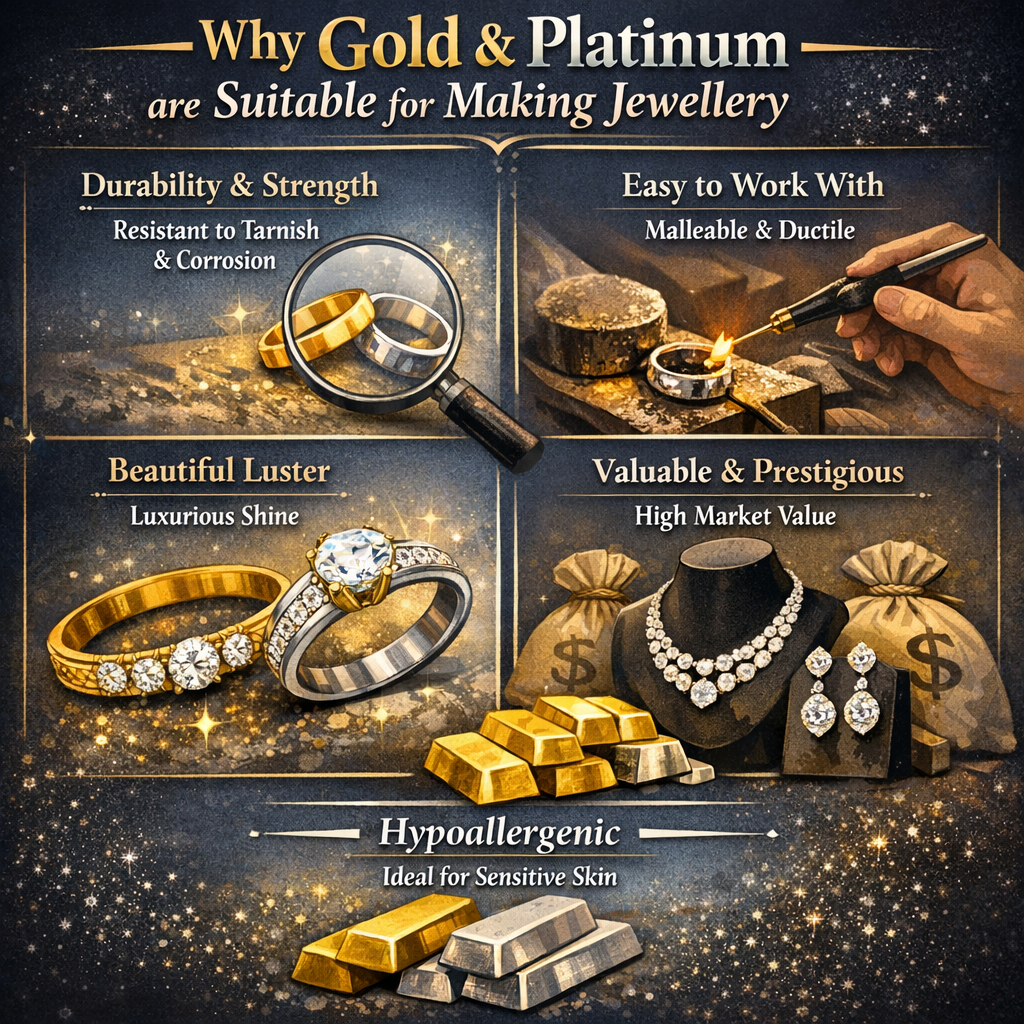
When exploring the foundations of fine adornment, consumers, collectors, and gemologists alike frequently ask why are gold and platinum suitable for making jewellery compared to alternative base materials. The answer lies at the intersection of metallurgy, chemistry, and timeless economic value. Throughout human history, these two precious metals have remained the undisputed standards for luxury fabrication. While modern industrial engineering has introduced titanium, stainless steel, and tungsten to the retail market, none of these alternatives possess the complete suite of mechanical and visual properties required for high-end, generational jewelry.
Creating a piece of fine jewelry requires a raw material that can withstand extreme thermal manipulation by a master artisan, survive decades of daily physical exposure, and retain its intrinsic market value. Both of these noble elements offer unparalleled performance across these critical vectors. This guide examines the structural mechanics, elemental purity, and long-term durability metrics that establish these noble metals as the foundational pillars of the modern jewelry industry.
The Historical Legacy and Evolution of Precious Metals
The utilization of high-value metals for personal adornment predates modern recorded history. Artifacts recovered from the royal tombs of Ur and ancient Egyptian burial sites demonstrate that early civilizations recognized the unique working characteristics of native gold millennia ago. Because gold often appears in nature in a relatively pure metallic state rather than locked within complex ores, ancient craftspeople could harvest and shape it using rudimentary hand tools. Its radiant, sun-like luster established an immediate cultural association with divinity, royalty, and immortality.
Platinum shares an equally fascinating, though chronologically distinct, historical timeline. Indigenous peoples of pre-Columbian South America successfully worked platinum-gold alloys centuries before European explorers encountered the material. However, when Spanish conquistadors first discovered the dense white metal in the streams of Colombia, they dismissed it as an impure, unworkable nuisance, naming it platina or “little silver.” Because pure platinum requires a remarkably high melting point—exceeding 1,768 degrees Celsius—European jewelers lacked the thermal technology to cast or solder the metal effectively until the invention of the specialized oxyhydrogen torch in the nineteenth century.
Once the thermal barriers to manipulation were overcome, platinum rapidly ascended to the pinnacle of high jewelry design during the Edwardian and Art Deco periods. Master jewelers like Louis Cartier leveraged its structural density to pioneer delicate, lace-like settings that could securely hold massive diamonds with minimal visible metal. Today, both metals carry a rich heritage of prestige, serving as tangible links between ancient craftsmanship and contemporary digital design methodologies.
Superior Chemical Inertness and Corrosion Resistance
At the most fundamental atomic level, the resilience of fine jewelry depends on its resistance to atmospheric and chemical degradation. Understanding the chemical stability of these elements clarifies exactly why are gold and platinum suitable for making jewellery meant to become heirloom pieces. Both elements are classified as noble metals, meaning they exhibit outstanding resistance to oxidation, tarnishing, and corrosion when exposed to ambient air, moisture, and common household chemicals.
Gold occupies a unique position on the periodic table as one of the least reactive solid elements in existence. It does not react with oxygen at any temperature, meaning a solid gold ring recovered from a centuries-old shipwreck will display the exact same brilliant surface finish as the day it was lost. It remains entirely unaffected by standard environmental acids, basic solutions, and sulfur compounds. Only highly specialized, aggressive chemical mixtures—most notably aqua regia, a concentrated blend of nitric and hydrochloric acids—possess the oxidative capacity to dissolve pure gold.
Platinum exhibits an even more formidable profile of chemical defense. It is highly resistant to chemical attack and does not oxidize in air at any temperature. This chemical inertness ensures that daily exposure to human perspiration, cosmetics, swimming pool chlorine, and saltwater will not cause structural degradation or surface scaling. Base metals like copper, iron, and silver readily react with atmospheric sulfur and moisture, resulting in unsightly black or green surface tarnishing that requires constant chemical stripping. The complete absence of chemical reactivity in gold and platinum ensures that fine rings, necklaces, and bracelets preserve their structural integrity and visual brilliance across generations of continuous wear.
Malleability and Ductility: The Jeweler’s Canvas
For a metal to be viable in master-level jewelry fabrication, it must yield precisely to the jeweler’s tools without fracturing, splitting, or experiencing premature work-hardening. This requirement highlights the distinct mechanical properties of malleability—the capacity of a material to deform under compressive stress without cracking—and ductility, the ability to stretch under tensile stress into thin wires.
Gold is universally recognized as the most malleable and ductile substance known to material science. A single ounce of pure elemental gold can be beaten into a translucent, continuous sheet measuring roughly 300 square feet, or drawn into a microscopic wire extending over 50 miles in length. This extraordinary plasticity allows bench jewelers to execute highly intricate metalwork, including hand-engraved scrollwork, delicate filigree wires, and paper-thin bezel frames. When a stone setter applies pressure to fold a thin lip of metal over the girdle of a fragile emerald or opal, the material moves smoothly and predictably, minimizing the risk of applying excessive shock to the gemstone.
Platinum possesses an exceptionally high degree of ductility, allowing it to be drawn into incredibly fine threads that retain remarkable tensile strength. This specific attribute enables the creation of micro-pave settings, where hundreds of tiny diamonds are held in place by microscopic beads of metal raised directly from the underlying band. Because the material does not become brittle during the drawing process, artisans can craft delicate structures that appear visually weightless while retaining absolute mechanical stability.
Comparative Mechanical Properties: Hardness vs. Durability
A common point of confusion among jewelry consumers involves the distinction between surface hardness and overall material durability. Hardness measures a material’s resistance to localized plastic deformation, such as scratching or indentation. Durability, conversely, encompasses the broader capacity of a piece to resist mechanical failure, fracturing, and long-wear mass loss over time.
Pure 24-karat gold is relatively soft, registering approximately 2.5 on the Mohs hardness scale and displaying a Vickers Hardness (HV) value of roughly 20 to 30. Because of this inherent softness, pure unalloyed gold easily bends out of shape and scratches under light friction. To make it viable for rings and bracelets subjected to daily impacts, metallurgists blend pure gold with harder secondary metals. Standard 18-karat gold alloys achieve a Vickers hardness of 130 to 160, offering excellent resistance to everyday abrasions.
Platinum alloys used in jewelry manufacturing generally exhibit a Vickers hardness ranging from 130 to 220 depending on the specific secondary elements utilized. However, platinum’s true structural superiority lies in its extreme density and atomic behavior under friction. When gold surfaces are scratched, tiny microscopic particles of the metal are sheared off and permanently lost. When platinum experiences an abrasive impact, the metal does not flake away; instead, the surface atoms simply displace or slide aside. This structural displacement gives platinum superior mass retention over decades of continuous wear.
Table 1: Physical and Chemical Comparison
| Metric / Property | Pure Gold (Au) | Pure Platinum (Pt) | Standard 18K Yellow Gold | Standard 950 Platinum |
|---|---|---|---|---|
| Atomic Number | 79 | 78 | N/A (Alloy Mixture) | N/A (Alloy Mixture) |
| Melting Point | 1,064 °C | 1,768 °C | ~880 – 920 °C | ~1,750 °C |
| Density (g/cm³) | 19.32 | 21.45 | ~15.2 – 15.9 | ~20.1 – 20.5 |
| Vickers Hardness | 20 – 30 HV | 40 – 50 HV | 130 – 160 HV | 130 – 220 HV |
| Reactivity | Inert | Inert | Extremely Low | Completely Inert |
| Wear Behavior | Metal Loss | Displacement | Moderate Loss | Patina Displacement |
Hypoallergenic Attributes for Sensitive Skin
Contact dermatitis resulting from metallic jewelry exposure represents a significant global consumer challenge. The primary culprit behind these localized skin irritations is nickel, a highly reactive base metal traditionally used to bleach yellow gold into white gold alloys. When exposed to normal human perspiration, nickel ions leach from the crystalline matrix of the alloy, penetrating the epidermal layer and triggering a persistent immune response characterized by redness, blistering, and severe itching.
High-purity precious metal formulations eliminate this biological risk entirely. Pure gold and high-grade platinum are completely biocompatible materials. Their exceptional chemical stability prevents them from breaking down or releasing metallic ions when exposed to the slightly acidic environment of human skin. Because the human immune system does not recognize inert noble metals as foreign contaminants, they provoke zero allergic reactions even when worn continuously in direct dermal contact.
For individuals with extreme chemical sensitivities, platinum remains the optimal clinical choice. Standard retail platinum jewelry is typically fabricated at a 95 percent purity level (marked as Pt950), with the remaining 5 percent consisting of similarly inert elements belonging to the platinum group metals, such as ruthenium or iridium. This high compositional purity guarantees absolute skin safety. High-end jewelers have also phased out nickel usage in premium white gold, substituting palladium—another noble metal—to achieve bright white coloration while preserving strict hypoallergenic standards.
Rarity, Intrinsic Value, and Market Trends in 2026
The global luxury marketplace operates on the foundational principles of supply scarcity and intrinsic monetary value. Fine jewelry functions not merely as personal decoration, but as a compact, transportable store of wealth. As of current global commodities tracking in 2026, both of these metals maintain robust market valuations supported by complex extraction logistics and finite geological reserves.
Gold remains the foundational reserve asset for central banks worldwide. The process of extracting elemental gold from deep underground veins is exceptionally resource-intensive. Industry analytics indicate that mining operations must process approximately two to three metric tons of raw ore to extract enough purified metal to produce a single standard wedding band. This natural supply constriction ensures that gold pieces maintain exceptional secondary resale liquidity regardless of shifting stylistic consumer trends.
Platinum is significantly rarer than gold within the Earth’s crust. Annual global platinum production volumes represent merely a fraction of total yearly gold extraction. Extraction is highly concentrated geographically, with the Bushveld Igneous Complex in South Africa accounting for the vast majority of the world’s primary supply. The metal’s critical utility in industrial clean energy applications, hydrogen fuel cells, and medical device manufacturing creates steady, non-discretionary baseline demand. Consequently, acquiring fine platinum pieces offers consumers an tangible exposure to an incredibly scarce, structurally critical commodity.
The Metallurgy of Alloying: Enhancing Strength and Color
Pure elemental gold and platinum are rarely used in their unalloyed native states for commercial jewelry production. Modifying these pure elements through precise alloying techniques directly addresses why are gold and platinum suitable for making jewellery that withstands decades of daily wear. By introducing specific ratios of secondary base or precious metals, master metallurgists manipulate the mechanical properties, grain structures, and optical wavelengths of the resulting material.
The karat system measures the purity ratio of gold alloys out of 24 total parts. Pure gold (24K) is alloyed with precise combinations of silver, copper, and zinc to produce classic 18K yellow gold (75% pure gold). To create rose gold tones, metallurgists increase the concentration of copper within the remaining 25 percent alloy mixture, leveraging copper’s natural reddish hue. Modern white gold requires aggressive bleaching agents like palladium or silver to mask the deep yellow tones of the primary metal, followed by a micro-thin surface electroplating of rhodium to achieve a mirror-like, brilliant white luster.
Platinum alloying strategies focus primarily on optimizing casting fluidity and structural hardness rather than color modification, as the native metal already displays a bright, naturally white aesthetic. Standard Pt950 formulations typically incorporate 5 percent ruthenium, iridium, or cobalt. Ruthenium-platinum blends yield exceptional hardness ideal for machined wedding bands and rigid structural settings. Cobalt-platinum variants produce a highly dense, fluid molten state that fills microscopic details perfectly during intricate investment casting operations.
Table 2: Common Alloys and Their Structural Benefits
| Base Alloy Designation | Composition Ratio | Primary Additives | Visual Aesthetic | Key Structural Advantage |
|---|---|---|---|---|
| 18K Yellow Gold | 75.0% Gold | Silver, Copper | Rich Warm Yellow | Optimized balance of hardness and malleability |
| 18K White Gold | 75.0% Gold | Palladium, Silver | Plated Bright White | Exceptional tensile strength for fine prongs |
| 18K Rose Gold | 75.0% Gold | High Copper, Silver | Warm Pink/Red | Superior hardness compared to yellow gold |
| Pt950 / Ruthenium | 95.0% Platinum | 5.0% Ruthenium | Natural Soft White | Maximum scratch resistance and rigid form |
| Pt950 / Iridium | 95.0% Platinum | 5.0% Iridium | Natural Soft White | Excellent malleability for hand-forging work |
Maintenance, Longevity, and the Patina Effect
The long-term visual performance of fine jewelry depends heavily on how the metallic surface responds to continuous ambient friction. Over decades of daily wear, rings and bracelets inevitably encounter hard abrasive surfaces. The contrasting ways in which gold and platinum absorb these structural impacts create dramatically different aging profiles.
As previously established, gold surfaces undergo micro-abrasive mass loss when scratched. Over an extended lifespan, an 18K gold ring will gradually wear thinner, particularly along the bottom shank where the band makes continuous contact with door handles, steering wheels, and desktop surfaces. White gold pieces introduce an additional maintenance cycle: the protective rhodium plating eventually wears away under normal friction, exposing the slightly yellowish native white gold beneath. Maintaining a flawless showroom finish on white gold requires periodic professional polishing and chemical re-plating.
Platinum responds to daily wear by developing a distinct, highly sought-after surface texture known within the trade as a patina. Because abrasive friction merely displaces platinum atoms rather than cutting them away, the surface develops a microscopic matrix of tiny intersecting displacement lines. This finish scatters reflected light, giving the metal a satiny, deep luster that contrasts beautifully with the sharp brilliance of polished diamonds. Many collectors prefer this authentic display of age, though a master jeweler can easily restore a platinum piece to a pristine mirror finish with minimal material loss.
Setting Precious Gemstones: Security and Structural Integrity
The ultimate test of any jewelry metal is its capacity to securely protect precious gemstones worth thousands or millions of dollars. The mounting mechanisms—whether delicate multi-prong arrays, smooth continuous bezels, or invisible tension channels—bear the continuous structural responsibility of holding stones firmly in alignment against external shocks.
Gold alloys provide excellent overall setting performance, particularly when engineered with tailored hardening elements. Traditional 14K and 18K white gold formulations display high yield strength and spring-back characteristics. When a bench jeweler notches a white gold prong and folds it over the girdle of a diamond, the metal retains a strong elastic memory, gripping the stone tightly. However, extreme blunt force impacts can cause thin gold prongs to snap or bend outward, potentially releasing the mounted gemstone.
Platinum represents the gold standard for high-security gemstone settings due to its complete lack of structural memory and extreme density. When a craftsman applies localized pressure to set a stone in platinum, the metal moves smoothly into position and remains absolutely dead-set where placed, exhibiting zero elastic spring-back. Furthermore, if a platinum prong suffers a severe impact during wear, its high ductility ensures that the metal bends plastically rather than shearing or fracturing. This fail-safe bending behavior prevents catastrophic stone loss, explaining why historic multi-million-dollar diamonds like the Hope Diamond are permanently housed within custom platinum mountings.
Environmental and Ethical Sourcing Standards in 2026
The modern luxury landscape has shifted dramatically toward absolute supply chain transparency, verifiable ecological stewardship, and strict humanitarian oversight. Contemporary consumers demand documented proof that their personal luxury purchases do not fund regional conflicts or contribute to irreversible environmental destruction. The global jewelry industry has responded by implementing highly sophisticated tracking frameworks for both gold and platinum extraction.
In 2026, the adoption of closed-loop recycled precious metals has reached unprecedented levels among tier-one retail brands. Advanced metallurgical refining facilities utilize high-temperature chemical recovery systems to reclaim pure elemental gold and platinum from obsolete electronics, catalytic converters, and vintage jewelry scrap. This recycled material is refined back to absolute elemental purity (99.99%), rendering it chemically and structurally indistinguishable from newly mined ore. Utilizing certified recycled stock allows manufacturing houses to reduce their carbon footprint and localized water consumption metrics exponentially.
For newly extracted minerals, organizations such as the Responsible Jewellery Council (RJC) enforce mandatory chain-of-custody audits. Primary platinum operations in South Africa lead the industrial sector in implementing large-scale solar arrays to power deep-level mining machinery, significantly reducing operational emissions. Primary gold mines now utilize non-toxic leaching alternatives to phase out traditional mercury-based extraction methods. Ultimately, the combined scientific, physical, and economic attributes demonstrate why are gold and platinum suitable for making jewellery of the highest caliber while meeting the progressive ethical expectations of the modern marketplace.
Frequently Asked Questions
Why does white gold turn yellow over time while platinum stays white?
White gold is naturally off-yellow and relies on a microscopic rhodium surface plating that wears away over time; platinum is an intrinsically pure white element throughout its entire structure.
Can platinum rings be resized as easily as standard gold rings?
Yes, but resizing platinum requires specialized high-temperature soldering equipment, dedicated eye protection, and distinct clean bench environments to prevent cross-contamination.
Is 24K pure gold appropriate for setting expensive diamonds?
No, unalloyed 24K gold is too soft and malleable to provide secure, long-term structural retention for high-value gemstone mountings under daily wear conditions.
Does a platinum ring feel noticeably heavier than an identical gold ring?
Yes, pure platinum is roughly 40 percent denser than standard 14-karat gold and approximately 30 percent denser than 18-karat gold, providing a distinctly heavy hand-feel.
Can wearing gold and platinum rings next to each other cause damage?
Yes, because platinum is denser and wears via atomic displacement, it will systematically scratch and wear down the softer adjacent gold band over prolonged contact.
Conclusion
The fabrication of heirloom-quality fine jewelry demands materials that transcend basic aesthetic appeal to deliver unyielding structural longevity, strict biocompatibility, and enduring intrinsic value. The scientific analysis of their atomic structures reveals that these two elements exist in a rare class of material perfection. Their total chemical inertness guarantees that pieces will not corrode, oxidize, or degrade over centuries of exposure to environmental elements.
Simultaneously, their unique mechanical properties provide bench artisans with the ultimate structural canvas. Gold offers unmatched malleability for flowing, intricate classical designs, while platinum provides extreme density and mass-retention characteristics that keep high-value gemstones locked safely in place. Whether investing in a traditional 18-karat bridal set or a dense, contemporary platinum band, consumers are acquiring a masterfully balanced piece of metallurgical science engineered to last for generations.
If you are currently evaluating materials for a custom engagement ring or a bespoke family heirloom, we strongly encourage you to consult with a certified gemologist or master bench jeweler to review the specific structural needs of your design. Request physical metal samples to compare the distinct weight variations firsthand, and inspect current market purity hallmarks to verify the ethical sourcing certifications of your selected alloy.